How Much Do Disconnected Systems Really Cost?
Disconnected systems, like having separate tools for membership, events, training, and payments, cost the average small-staff organization 15–20 hours per week in manual data reconciliation, according to American Society of Association Executives (ASAE) benchmarking data. That hidden productivity drain translates to $30,000–$50,000 annually in staff time that could be redirected toward members and programming. In addition to creating inconvenience, disconnected systems quietly drain time, reduce accuracy, and limit an organization’s ability to grow.
Studies estimate that employees spend up to 20–30% of their workweek searching for information or switching between tools, while frequent context switching can reduce productivity by as much as 40%. For associations, chambers, and nonprofits operating with lean teams, that lost time adds up quickly. What looks like a manageable set of tools on the surface often creates a hidden operational burden behind the scenes.
What Are Disconnected Systems?
Disconnected systems are separate software tools that do not share data or integrate effectively, forcing staff to manually transfer information between platforms.
This often includes:
- A membership database stored in spreadsheets
- Event registration handled through third-party tools
- Email communications managed in a separate platform
- Financial data tracked independently
Instead of working from a single source of truth, staff are left piecing together information across systems. If your organization is relying on a patchwork of tools and spreadsheets, it’s time to reconsider. These disjointed workflows are costing your organization.
How Do Disconnected Systems Impact Staff Productivity?
When systems don’t communicate, even simple tasks become time-consuming. Research shows that employees spend nearly an hour each day searching for information across disconnected apps, while many report difficulty tracking work across systems. A membership manager updating contact information may need to make that change in multiple places. An event coordinator might export attendee lists and manually reconcile them with member records. Leadership teams often wait days for reports that require compiling data from several tools.
For staff, this creates constant friction. For leadership, it limits visibility. No one wants to work with outdated or disorganized systems. If your staff is spending more time managing tech problems than delivering value to your members, it can lead to:
- Frustration and burnout
- Inconsistent performance
- Higher training costs for new hires
- Difficulty retaining top talent
Many organizations begin addressing these challenges by moving to a membership management software. Jumbl, a modern, all-in-one platform, not only simplifies work, it helps you retain good people who want to make an impact.
What Are the Hidden Costs of Using Multiple Tools?
The cost of disconnected systems is rarely captured in a single line item, but it shows up across the organization in several ways:
Lost Time
Staff spend hours each week switching between platforms, exporting data, and correcting inconsistencies. In many organizations, this results in hours of duplicated effort every week, time that could otherwise be spent engaging members or growing the organization. These inefficiencies are often invisible in budgets but measurable in output. Studies estimate that employees lose up to five working weeks per year due to app switching and fragmented workflows.
Increased Errors
Manual data entry introduces mistakes, from duplicate records to incorrect billing or event attendance tracking. Without a single source of truth, reports become unreliable or, even worse, error could lead to sensitive data being breached as it is passed between systems.
Inferior Member Experience
Members don’t see the behind-the-scenes juggling act, but they feel it:
- Receiving renewal reminders after they’ve paid
- Needing to re-enter their information for every event
- Receiving impersonal communications
- Encountering outdated information
Disjointed systems often lead to inconsistent communication, redundant data requests, and missed opportunities. Over time, that erodes trust and reduces retention.
Delayed Decision-Making
Reports take longer to generate, making it harder for leadership to act quickly or plan effectively.
Why Do Associations Struggle with Fragmented Data?
Many organizations didn’t choose disconnected systems intentionally. Most evolved into them. A chamber might start with spreadsheets, then add an email tool and then an event platform. A nonprofit may adopt new tools over time to solve immediate needs without replacing older systems.
While each tool may work well individually, the combination creates operational silos. On the surface, it may seem manageable; however, behind the scenes, it is costing more than you think.
Attempts to patch systems together with integrations often provide temporary relief, but they rarely eliminate the underlying complexity. Over time, organizations find themselves maintaining the connections instead of benefiting from them.
What Does This Look Like in Practice?
Consider a mid-sized association managing events through one platform, memberships in another, and communications in a third. After each event, staff export attendance lists, compare them against membership records, and update engagement manually. This process can take several hours or even days after larger events.
Now multiply that effort across multiple events, renewals, and reporting cycles.
This is where the hidden cost becomes visible.
Why Patching Systems Together Doesn’t Solve the Problem
Many organizations attempt to solve fragmentation by adding integrations or additional tools. While this can improve specific workflows, it often introduces new challenges:
- Integrations require ongoing maintenance
- Data syncs can fail or lag
- Staff still need to understand multiple systems
- Complexity continues to grow over time
Instead of simplifying operations, these approaches often shift the burden rather than eliminate it. This fragmentation often emerges when organizations rely on tools that weren’t designed to work together, rather than a unified membership database.
How a Unified Platform Changes the Equation
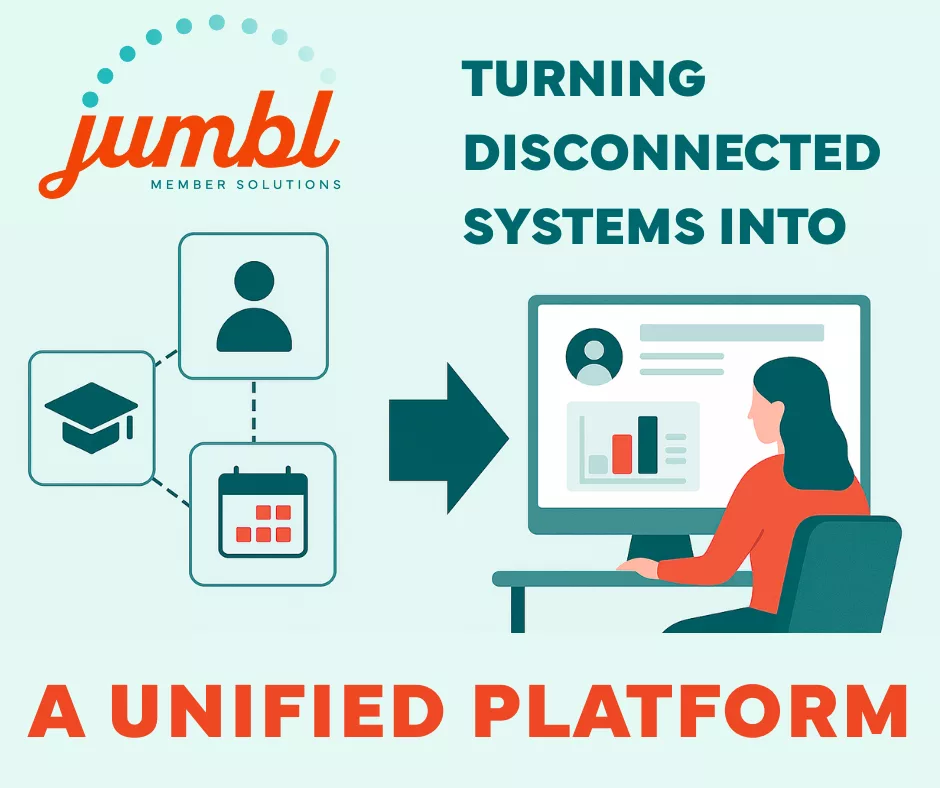
A centralized system replaces fragmented workflows with a single, connected environment. Instead of managing multiple tools, organizations can:
- Maintain one accurate member database
- Connect events directly to member records
- Automate communications based on real engagement
- Generate reports instantly without manual compilation
This shift saves time, and it creates consistency across the entire organization.
The Jumbl Solution: One Platform, Unified Workflow
Jumbl empowers your team to do more with less friction and more focus.
Jumbl by Element 74 was built to eliminate hidden costs. Instead of juggling multiple tools, trade associations, professional associations, chambers of commerce, and nonprofits using Jumbl can:
- Manage members, training, and events in one place
- Pull real-time reports from a single source of truth
- Customize experiences based on segmentation and engagement
- Reduce manual work and increase transparency
A Real-World Perspective
Before Jumbl, one of our clients found themselves juggling multiple databases and software tools. Now, they manage nearly everything through one easy-to-use system. This change has streamlined their processes and eliminated hidden costs. “The efficiency and convenience it has brought to our team are incredible. Jumbl has truly transformed how we work, and we’re excited to keep growing with the platform.” Kristie Fortier, Membership Director, Missouri Press Association
What Should You Look for in a Unified System?
Not all platforms solve the same problems. When evaluating options, organizations should look for:
- Ease of use for staff without technical expertise
- A true single source of truth for member data
- Native event management and registration tools
- Integrated communication capabilities
- Built-in reporting and analytics
- Unlimited support from real humans who care
Start Reducing the Cost of Disconnected Systems
Disconnected systems may feel manageable day to day, but their long-term impact can limit growth, reduce efficiency, and create unnecessary strain on your team. Jumbl brings membership management, event registration, communications, and reporting into one platform, helping associations, chambers, and nonprofits simplify their operations without adding complexity.
For organizations ready to move beyond patchwork solutions, Jumbl provides a practical path forward …one that supports both daily efficiency and long-term growth. Contact us today.
Ready to connect the dots?
Frequently Asked Questions
What is a disconnected system in an association?
A disconnected system refers to separate tools that do not share data, requiring manual updates and coordination between platforms.
How much do fragmented tools cost organizations?
While costs vary, research shows teams can lose up to a full workday each week due to inefficiencies like data searching, duplication, and context switching.
Can small organizations benefit from a unified platform?
Yes. In fact, smaller teams often benefit the most, as they have fewer resources to manage complex systems and manual processes.
Is it better to integrate tools or replace them?
Integrations can help in the short term, but many organizations find that a unified platform provides greater long-term efficiency and scalability.